← Stream of Consciousness Workshop
Module One
Linear vs. Non-Linear Storytelling
You already know how stories work. Someone tells you what happened, in order. There’s a beginning, a middle, and an end. The dragon attacks, the knight fights, the princess is saved. The storyteller is in charge, and everything makes sense.
But what if you told a story a completely different way?
What if, instead of standing outside the story and explaining what happened, you were inside a character’s head? Not organizing their thoughts for them, but hearing everything as it comes—jumbled, messy, full of feelings and random memories and the smell of something cooking downstairs?
This is the difference between linear storytelling and what writers call stream of consciousness. In a linear story, the author is like a tour guide, walking you through events in a logical order. In stream of consciousness, you’re wearing headphones plugged directly into someone’s brain.
The Tour Guide vs. The Headphones
Think about the fairy tale of St. George and the Dragon. A traditional telling gives you the facts: George arrives. The dragon threatens the princess. George fights. The dragon dies. The end. The storyteller knows everything and tells you only what matters.
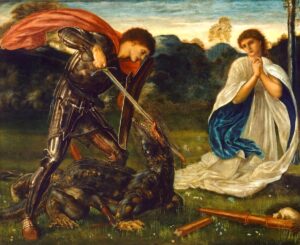
But what if you were inside the princess’s head during the fight? She might be terrified. She might notice the mud on George’s boots and wonder where he came from. She might suddenly remember a song her mother sang, or feel hungry, or worry about whether her hair looks terrible. None of these thoughts “make sense” for the story—but they’re exactly what a real person would think.
That’s stream of consciousness. It’s what thinking actually sounds like, before anyone cleans it up.
Why Does This Matter for Writers?
Most of the writing you’ve read has been cleaned up. Organized. Made logical. And that’s fine—it’s one powerful way to tell a story. But the writers we’ll study in this workshop discovered something: sometimes the mess is the point. Sometimes the most honest way to show a character is to let the reader experience the chaos of their thoughts.
Over the next five modules, we’ll explore this technique. We’ll listen to music, look at paintings, read passages from great writers, and—most importantly—try it ourselves.
Watch
Before you try the writing exercise below, watch this short clip. Eadweard Muybridge’s famous horse-in-motion photographs from 1878 broke a single flowing movement into a series of frozen instants. Think of stream of consciousness the same way: not one grand picture of a story, but a series of quick impressions, one after another, the way your mind actually works.
Eadweard Muybridge’s “The Horse in Motion” (1878) — movement captured as a series of fragments.
Writing Activity
The Fairy Tale Flip
- Pick a fairy tale you know well—Cinderella, Little Red Riding Hood, Jack and the Beanstalk, any one you like.
- Choose one moment in the story (not the whole thing—just one scene).
- Now rewrite that moment from inside the character’s head. Don’t explain what’s happening. Instead, write down everything the character might be thinking, feeling, noticing, and remembering—even if it has nothing to do with the story.
- Write for 10 minutes. Don’t worry about making it “good.” Just let the thoughts flow.
For Teachers & Parents
The goal here is simply to loosen up. Most young writers have been trained to write in organized paragraphs. This exercise gives them permission to be messy.
Don’t correct grammar, logic, or structure. If a student writes something that jumps around wildly, that’s a success. After writing, ask them to count how many different subjects appear in their piece—most will find five or more topics in just ten minutes of writing.