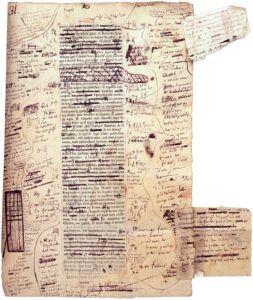
In 1833, when Balzac was writing Eugénie Grandet, there were no computers. There were no typewriters. Balzac wrote in ink, by hand. The first time he saw his work in print was on page proofs sent from the printer. What we see on this remarkable page, held at the Morgan Library in New York, is that the printed text was, for Balzac, what we would now think of as a draft.
Today, we see our work typed as we write. We edit as we go along.
What is the Purpose of Revising?
The purpose of revising is to clarify ideas. It is make your story or poem more effective at saying what you want to say. The clearer you are about what your work is about the less revision you will need.
How Much Revision You Need May Be A Lot, or None.
How much editing do you need to do? That depends. The answer might by anything from none to a lot.
How much editing is required depends on your working style. It depends on how familiar you are with the kind of writing you are doing. It also depends on how fully finished the piece needs to be. All writers have pieces they work up to be the best they can make it if they are sending it off for publication. But, if you are largely writing for yourself, then work on your piece until you find that it is good enough for what you had set out to do. And then, move on to something new.
It is important to remind yourself that no piece of writing can ever be finished in the way an industrial product can be finished. When a washing machine comes off the production line it is finished! There is nothing more than can be done. But you are making art. Words can always be rearranged. You can always replace one word with another to convey a slightly different feeling. Different words carry different rhythms. And in fiction and poetry a change in rhythm can be important. But, there comes a point when it is time to recognize that you are just fiddling and that it is time to move on to the next piece.
Reading Your Work Aloud.
Here is the most important piece of advice I can give you on the subject of editing. An editor once said to me, “William, read your writing aloud to yourself. If it sounds good, you are done.”
That is advice I am giving you. It may be the most important writing advice you are given. It is the best advice I was ever given.
Read your work aloud as you are writing. I am sometimes sounding to the words as they flow into the computer. As you finish a paragraph stop to read it aloud. And when you feel that your work is finished, then read from the beginning. If it is a long work, then break the reading into sessions. I cannot emphasize how reading aloud enables you to get a full sense of what you have written and how a full reading will show up minor things to change and at the same time give you the confidence to know that you have done a good job and can now relax.
Can AI Help with Editing?
Can AI help with editing? For creative writing the answer is simple. AI can correct your spelling, but for creative writing, that is all. English as two spelling traditions — British and American. If you live I India, the UK, or some other country that uses British spelling, then tell the AI to correct your work for British spellings. If you are American or Canadian, then ask for American spelling.
AI and other grammar tools are not useful when you are writing fiction. AI grammar tools might be helpful when you are writing nonfiction. But with fiction the how you say what you say is tied up with your story. You may have a character who may not speak in standard English. While it is always important to know the rules of English grammar and how to write the clearest cleanest prose for a persuasive essay, creative writing is not a persuasive essay.
To be a persuasive writer of fiction you need to be able to write and English that an AI engine might sometimes want to correct. I am not saying that you can write any which way as long as it is fiction you are writing. What I am saying is that you may want to break some rules to write a less standard English in order to tell your story in the most effective way.
AI does not always listen. You may prompt it, “Correct [American] [British] spelling, only,” but what it does is a full review. If that happens, just repeat your instruction. Tell it, “I asked for [American] [British] spelling corrections, only.” You can ask for a list or you can ask it to, “Please re-output the text with the spelling corrections.” .
What about punctuation? Punctuation is trickier. That is because punctuation can be a matter of style. My advice is to focus on punctuation when you are reading aloud. Make the punctuation follow how you read. You may want lots of commas. You may not want lots of commas.
Let the sentences and paragraphs you write fit the demands of your story. If a sentence that runs on helps you tell your story, then let the sentence run. You are the author. We are talking about creative writing. This is art. As an artists, you have flexibility. Your prose style needs to come from within you. Be careful of advice from adults and from computers.
Develop Skill and Confidence Through Practice
In the end, you need to write write write write, and write some more. Develop confidence in yourself. Don’t let any person or any computer push you around. Maybe you parent or your computer are right! But, you need to find out what is right yourself. That is how you become a strong writer. A strong artist.