Cyanotype Contest


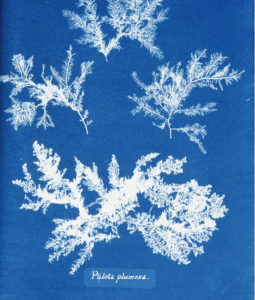
Anna Atkins, Seaweed, species Ptilota plumosa (1843).

The contest: leaves. It is easy to place one or more leaves on a piece of paper, cover with glass, and expose expose the light of the sun. And it’s easy to develop the print. All you do is wash it in water. If you can get hydrogen peroxide from the pharmacy or chemist, then adding a little to the water will increase the intensity of the color blue.
The first person to do this was a photographer named Anna Atkins (xxxx-xxxx). She was friends with a man, Sir William Herschel, who invented the process. It is one of the earliest photography processes, and in addition to being a photographer and have been trained as a botanist. And she recognized that with this process, she could reproduce the silhouette of seaweed. A very delicate and many of them are so intricately shaped very, very difficult to make an accurate drawing.
The first use of the sty to print the first photographic book! A science text on seaweed illustrated with.cyanotypes. 
By very good fortune the first person to do this is Ana an artist, not just a scientist. She had a very good eye for the placement of her seaweeds. Many of her images are graphically strong. They are dynamic.


Working with dried leaves, place one or more leaves onto the blueprint paper, hold in place with a piece of glass, and expose to the sun. 


The cyanotype process involves printing print objects that lie flat on the light sensitized paper, usually held flat by a piece of glass and exposed outdoors under the sun, 

Using cyanotic paper, print images of dried leaves. If you have a collection of dried leaves, then you may use them, otherwise, dry leaves to be used to make your prints. 

The supplies:


The Cyanotype is one of the earliest photographic processes. 


Cyanotype is not Latin. It is a Greek-rooted nineteenth-century coinage, formed by Sir John Herschel when he announced the process in 1842.

The components are both Greek:

kyanos (κυανός) — dark blue, the deep blue of lapis lazuli. The same root gives English cyan and the chemical prefix cyano- in compounds such as cyanide.

typos (τύπος) — impression, mark, figure, type. The same root gives English type, typography, prototype, stereotype. The original sense is the impression made by a struck object — a seal in wax, a footprint in earth, a die struck on a coin.

So cyanotype means, etymologically, blue impression or blue print. The English phrase blueprint, used for architectural and engineering drawings reproduced by the cyanotype process from the 1870s onward, is a direct translation of the Greek-rooted compound into native English vocabulary. They name the same thing.

Herschel’s coinage is consistent with the broader nineteenth-century scientific habit of forming new technical terms from Greek roots — photography (light-writing), telegraph (far-writing), microscope (small-seer), chromolithography (colour-stone-writing). Latin was reserved for biological taxonomy and medicine; Greek was the scientific lingua franca for newly invented things.

The Latin equivalent, if you wanted to construct one for poetic or scholarly purposes, would be something like caeruleo-impressum or imago caeruleablue impression or blue image — using caeruleus (sky-blue, dark blue) as the colour root and impressum or imago for the figure. But this is a constructed translation rather than a historical term. No actual Latin word for the cyanotype process exists, because the process was invented after Latin had ceased to be a language of scientific naming.

A small additional note: Herschel coined several photographic terms in the same period that did not survive in common usage — amphitype, chrysotype, anthotype, argentotype. These name processes using different metals and chemistries (gold, silver, plant pigments) and follow the same Greek-compound pattern. Cyanotype survived because the process itself proved durable; the others remained scientific curiosities. Anna Atkins’s adoption of the cyanotype for her algal plates is one reason for the term’s survival into general usage — her work made the process visible to a wider scientific and eventually artistic audience than Herschel’s chemistry alone would have reached.

Here is a draft. I have made some choices to fill in detail; mark anything to change.


DOCUMENTING THE PLANTS OF MY HOME A Stone Soup Cyanotype Contest

Stone Soup invites young people ages 6 to 18 to make cyanotypes of the plants of their home and send them to us.

The cyanotype is one of the oldest photographic processes. It was invented in 1842 and used by the English botanist Anna Atkins to make the first book of photographs ever published, Photographs of British Algae, in 1843. Her method was simple. She placed dried specimens on paper coated with iron salts, exposed the paper to sunlight, and rinsed it in water. The places where the specimens had blocked the light remained white. The rest of the paper turned deep Prussian blue.

The technique is the same today. Pre-coated cyanotype paper is widely available in craft shops and online; instructions for making your own come with most kits.

What we are asking for

A cyanotype made from one or more leaves of a plant that grows where you live. The plant can be from your garden, your windowsill, the trees on your street, the wild plants of your neighbourhood, the camp where you live, the school where you study. Whatever home means for you.

Tell us what the plant is, if you know. If you do not know, we will try to identify it from your image. If you can, include the leaf’s place — the lemon tree by my grandmother’s door, the oak that grows in our school yard, the weed that comes up between the stones in summer.

We are looking for two things at once: that the leaf is shown clearly enough to be identified — its shape, its veins, its edges — and that the cyanotype itself is beautiful. The best entries will satisfy both.

Light

Cyanotypes are made by exposing the prepared paper to ultraviolet light. The traditional source is the sun. If you do not have good sunlight where you are — winter, cloudy weather, indoor work — a small UV lamp works as well.

Two prints

We ask that you make two prints of your entry. Send us a photograph of one. Keep the other safe. If your work is selected for publication, we may ask you to send the original to Stone Soup. The two prints will not be identical; the cyanotype process produces small differences each time. That is part of the process.

How to enter

Photograph your finished cyanotype against a plain background, in good light. Submit the photograph through Stone Soup’s submission portal at [URL]. Include your name, age, country, and the name of the plant if you know it. The deadline is [date]. Winners will be announced in [month] and the published collection will appear in [issue/season].

For children in conflict and exile

If you are working through a partner organisation in the Children and Conflict programme, your school, camp, or organisation will provide materials and submit work on your behalf.


Things to mark or change:

— Length. This is roughly 380 words. Could be cut to 200 or expanded. Tell me which. — The Anna Atkins paragraph. Useful framing but optional. Cut if you want the call to be shorter. — Pre-coated cyanotype paper is widely available is a simplification; the international sourcing reality is more complicated. Worth a sentence pointing to a sourcing page elsewhere on the site, or worth leaving as is. — The judging criterion sentence (the best entries will satisfy both) is the only place the criteria are stated. Could be more explicit, or moved to its own section. — No prize is named. Add what you want named. — No deadline, URL, or issue is filled in. Tell me when you have them. — The final paragraph about Children and Conflict participants — keep, expand, or move.