The subject of the contest is plants and flowers from your home and neighborhood
The contest is for images of leaves and flowers from your home and neighborhood. You may use leaves used in cooking, plants growing in flower boxes and gardens, and plants you find outside in your neighborhood.
What to enter
- You may enter more than one image.
- Label each image with the name of the plant in English or other language.
- Scanned images preferred.
- If you upload photographs of your cyanotype(s) then please be sure the photographs fill the frame and are evenly lighted. Blemishes in the cyanotype paper itself will not count against your submission, but the quality of your photograph does count, so please send the sharpest image you can.
Drying leaves and flowers
The first step to making a cyanotype or “sun print” is to pick leaves and flowers to dry. If you have never dried leaves or flowers before then you are in for a treat. The process is simple. Pick leaves and flowers whose shapes interest you. Dry leaves and flowers sandwiched between sheets of uncoated paper. Newspaper is ideal. Just don’t use paper that shiny, like paper used in many magazines. Place something heavy, like a book on top of what you are drying. Depending on your climate they may dry quickly — in a day — or take longer — even a week.
Seaonal issues!
Sun print paper is sensitive to UV light. Traditionally, the prints are made directly under strong sunlight. It is the UV in the sunlight that is doing the work. Printing works best when the light is strong. Depending on where you live, this may make sun printing seasonal. If you become engaged with making cyanotypes, then you can also purchase UV lights so you can expose your prints in your house without regard to the sun.
What the judges are looking for
The judges are looking for poetry. The judges are looking for images that are dynamic in some way. Images that reward multiple viewing. The judges will be looking for images that speak to them through their shapes and placement on the page. A leaf that is exactly centered on the paper might make a strong image, or it might feel a little boring. Small changes in leaf or flower position can make a big difference to how the images “reads,” so experiment with placement.
What is a cyanotype?
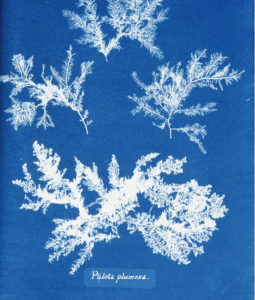
A cyanotype is an early photographic process dating to the early 1840s. Anna Atkins (1799-1871) was the first photographer to use the process in a big way. She published a book illustrated with cyanotypes. This book of cyanotype photographs of British seaweed was published in 1843. Because she was an artist as well as a scientist, her images are unusually beautiful.
Atkins first collected seaweed and then dried the specimens. She made her cyanotypes by placing the dried specimens on paper that had been sensitized to light with chemicals. She covered the specimens with a piece of glass so the paper would stay flat. The paper was then exposed to sunlight for some minutes. This part takes experimenting to work out how many minutes on the day you are working. But, once you work that out, then after the required time in the sun the glass is removed and the paper is immersed in a tub of water. The image develops in water.
A trick that photographers who use this process sometimes use to make the blue as deep as possible is to add a little hydrogen peroxide to the water. Experiment to find the right amount. Hydrogen peroxide can be purchased at most pharmacies.
Where can I purchase the cyanotype “sun print” paper?
Cyanotype or “sun print” paper can be purchased in some countries at art supply stores. You can also purchase from Amazon.com and from Aliexpress.com. The papers purchased from Aliexpress can vary in quality. They sell from many suppliers. Some excellent. Some not so perfect. Your print will not be judged negatively because of imperfections in the paper used to make them.