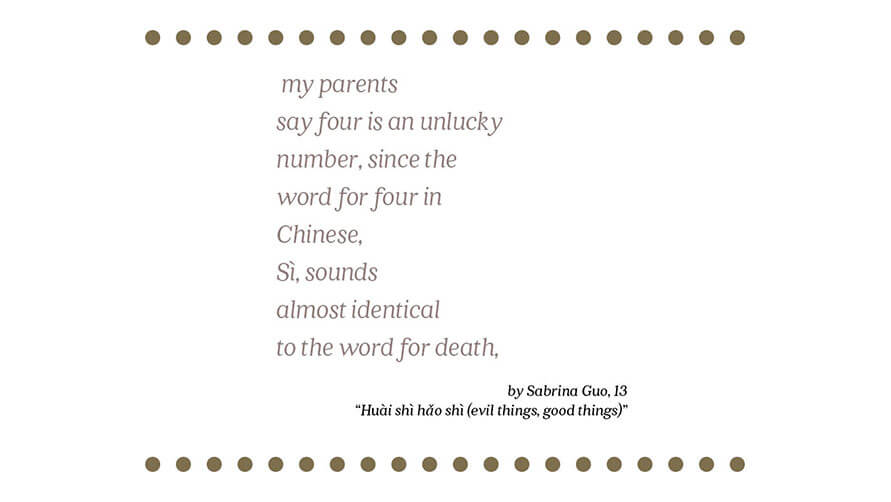

Every New Year’s Eve,my friend tells meshe smashes sixpomegranateson her lawn,and when I ask her why,she says it is becauseshe is Greek, andwhen I want tounderstand moreof what she means,I read up on pomegranatesin Greek mythology,discovering that afterPersephone was abductedby Hades and joined him inthe underworld,her mother Demeter mourned bydrying the Earth in a long, cold winter,until Zeus arranged forPersephone’s return,but because Persephone hadbeen tricked intoeating six pomegranate seeds,she had to return to Hadesto spend every winter with himin the darkness,and I wonder if thisis why my friend breakspomegranates atnight on her lawn,as if the more they break,the more their seeds are spread,and the more luck and fertilitythere will be in the New Year,which is not so different frommy own superstition aboutmy need to squeezemy eyedroppersix times,never four,because my parentssay four is an unluckynumber, since theword for four inChinese,Sì, soundsalmost identicalto the word for death,and the only difference isthe level of inflectionwhen pronounced,and it seems strangethat the six seedsPersephone ate would have beenso unlucky for her,but without her misfortune,there wouldn’t be new seasonsto wish for,just as without the numberfour, I couldn’t learnto love the number six,and maybe that is whymy friend and I aren’tso different as we seem—when she tells me aboutthe pomegranatepulp in her yard,tiny seeds clingingto frozen bladesof grass in thenew Januarycold I have cometo understand what shemeans.